

Hybrid Cloud Best Practices – Manage your Environment with Ease
Infrastructure Managed Services

A hybrid cloud environment, which spans private cloud instances and public cloud platforms, offers distinct advantages over an exclusively private or public cloud architecture. However, hybrid clouds can be challenging to set up and manage.
Issues include complexity, visibility, performance, security, and cost. This article offers some hybrid cloud best practices that enable infrastructure managers to tackle these challenges and get the most from their hybrid clouds.
Jump-to Section
Key Benefits of a Hybrid Cloud
Common Issues with Hybrid Cloud Infrastructures
5 Best Practices for Managing Hybrid Cloud Environments
1. Define and Enforce Meaningful Security Policies
2. Understand Roles and Relevant Policies
3. Place Workloads in Optimal Environments
5. Monitor Performance and Optimize Wherever Possible
What are the Recommended Best Practices for Hybrid Cloud Migration?
4. Plan for Security and Governance
5. Design for Performance and Simplicity
7. Back Everything Up Before You Start
8. Keep People and Skills in Focus
Improve your Hybrid Cloud Management and Transition with Park Place Technologies
What is a Hybrid Cloud?
A hybrid cloud computing environment extends from a private cloud to a public cloud platform such as Microsoft Azure or Amazon Web Services (AWS), and a hybrid cloud enables data and applications to move seamlessly between them. The private cloud component might be hosted in a company-owned data center or at a colocation facility.
Hybrid clouds are popular because they enable flexibility in terms of data security and workload optimization. The hybrid cloud owner can store sensitive data on-premises while taking advantage of specialized processing capabilities in the public cloud. They are also potentially more economical than relying solely on a private or public cloud approach.
Key Benefits of a Hybrid Cloud
Here are the two key benefits of adopting a hybrid cloud:
-
Flexibility – A hybrid cloud approach offers organizations the flexibility to balance control with scalability.
By combining private infrastructure with public cloud resources, businesses can keep sensitive or regulated workloads in a controlled environment while still taking advantage of the elasticity, on‑demand capacity and rapid innovation available in public cloud platforms. This blended model gives organizations the “best of both worlds,” allowing them to run workloads where they perform best—whether that’s locally for low‑latency or compliance reasons, or in the cloud for cost efficiency and scale.
-
Resilience and Operational Agility – A hybrid architecture allows workloads to move between environments based on performance needs, cost considerations or unexpected demand, reducing risk and avoiding bottlenecks.
It also enables organizations to modernize at their own pace, integrating cloud‑native services without abandoning existing investments in on‑premises systems.
This approach supports long‑term adaptability, helping businesses respond quickly to new opportunities while maintaining the reliability and control of their established infrastructure.
Hybrid clouds are popular, with industry data revealing that 54% of enterprises use the architecture for mission-critical workloads. Overall, 70% of enterprises use hybrid cloud environments, according to Flexera’s 2025 State of the Cloud Report.

Common Issues with Hybrid Cloud Infrastructures
Though the advantages are clear, a hybrid cloud infrastructure can come with its share of challenges. Some of the most important things to consider include:
-
Staying Secure and Compliant—It is easy to lose track of security controls and compliance measures when data and application functionality swing back and forth between private and public clouds.
For example, there can be gaps in configuration that expose APIs to unauthorized use. Data moving between cloud instances is vulnerable to breach. Users could even neglect to follow policy and store sensitive data with little to no protection. Identity management can be difficult to enforce across the two environments.
- Complex Management —Hybrid clouds can be challenging to manage, especially if those responsible are not well-equipped with sufficient tools. For instance, while some hybrid cloud solutions enable management over both environments at the same time, additional specialized tools are required to manage on-premises and public clouds.
- Integrating Disparate Systems—Integrating the various pieces of a hybrid cloud architecture can be a time- and resource-intensive task. Tools and APIs tend to be different on public and private clouds. This can make interoperability difficult to establish and maintain.
-
Staffing for Hybrid Cloud Management Teams—Administering public and private cloud platforms requires different skillsets. It can be challenging to recruit and retain people who are able to manage hybrid clouds.
If employees are not available, it may be necessary to outsource responsibilities to an infrastructure managed services partner.
-
Managing Costs— The public cloud element of a hybrid cloud may have hidden and unpredictable costs. For example, data egress fees from cloud storage can fluctuate widely from month to month.
Alternatively, if admins spin up public cloud instances but fail to remove them when they are no longer in use, the enterprise will waste money paying for infrastructure that serves no purpose. Software licensing and consultants can also add to the cost management burden. The private cloud capabilities within a hybrid cloud deployment can alleviate some of these high costs. It’s also important to ensure the environment is managed properly, with an experienced IT team.
- Maintaining Consistent Performance and Reliability—Network issues across different cloud environments is common, likely due to the dissimilar frameworks used. This can affect the performance of a hybrid cloud.
- Monitoring both Environments Equally Well—The distributed nature of hybrid clouds makes it hard to get visibility across the entire hybrid cloud environment. Each platform may have its own IT infrastructure monitoring tool, but it’s best to have centralized tracking of performance and configurations.
5 Best Practices for Managing Hybrid Cloud Environments
A number of best practices regarding management of hybrid cloud environments have emerged in recent years. They enable organizations to get the most out of hybrid cloud infrastructure while avoiding the challenges that hinder positive outcomes.
Here are some of the most common best practices for hybrid cloud:
1. Define and Enforce Meaningful Security Policies
Enforcing best practices for hybrid cloud management should start with security. Effective countermeasures are critical for mitigating the risks of data breaches and denial of service (DoS) attacks. One best practice here is to adopt a multi-layered, defense-in-depth security strategy that includes data encryption and strict access controls.
An effective defense-in-depth strategy will benefit from implementing a zero-trust access policy across all public and private cloud instances. Enforcing zero trust might require the use of a cloud access security broker (CASB). Hybrid cloud security should also include regular audits and continuous threat monitoring.
Additionally, countermeasures such as immutable backups, which use cryptography to make it impossible for anyone to delete or alter data stored on a hybrid cloud architecture, reduce the potential impact of ransomware attacks.
2. Understand Roles and Relevant Policies
Hybrid clouds usually translate into hybrid teams or multiple teams collaborating on managing the public and private halves of the environment. This can be problematic if something goes wrong, as teams will not take accountability for arising issues.
It’s a good idea to be clear about roles, responsibilities, and policies, for example, defining clear policies about data security and compliance. In this example, this will reduce the likelihood that a staffer will assume that encryption is the other team’s responsibility. Training is necessary to achieve these goals, as is clarity about lines of communication, authority, and accountability.
3. Place Workloads in Optimal Environments
Hybrid cloud workloads should ideally align with the resources where they’re deployed. For example, a company’s website needs greater scalability so would benefit running on a public cloud. But financial systems should run a private cloud environment, due to the need for stronger compliance. Though this example is regarding performance, placing workloads in optimal environments can also affect cost.
For example, if a workload generates data that will rarely be used, like archived data, then it makes no sense to store it on costly high-performing storage. Instead, the data should go on the least expensive “cold” cloud storage. Optimizing workloads is not a static process. You will want to evaluate workload placement on a regular basis and move things around as requirements change.
4. Map Dependencies
Hybrid clouds often feature complicated dependencies between applications, infrastructure components and databases. To get the best results from the infrastructure and minimize administrative hassles, it’s wise to map these dependencies.
By doing this, you can understand how workloads interoperate in both public and private cloud environments—simplifying the process of correcting problems and avoiding the potential of deploying a workload in a way that “breaks” something. This is relevant for best practices for hybrid cloud in tech, an industry that often features complex cloud architectures.
5. Monitor Performance and Optimize Wherever Possible
You need to keep a close, constant eye on hybrid cloud environments, because they sometimes cause unexpected performance issues. These can arise for a variety of reasons, including network traffic overload and server capacity bottlenecks.
Monitor hybrid cloud performance constantly and be ready to remediate problematic situations. This might involve steps like changing configurations and adding or removing resources. Success depends on using the right tools and establishing key metrics and benchmarks up front.
What are the Recommended Best Practices for Hybrid Cloud Migration?
No two hybrid cloud migrations are the same, but regardless of scale or scope, the following best practices will help ensure that your data center migration goes smoothly and offers few surprises:
1. Align with Business Goals
Why are you adopting a hybrid cloud? There should be a compelling reason for it, or else it will be an expensive waste of time. The hybrid cloud should therefore align with business goals.
For example, do you need seasonable scalability? Are you expecting a significant surge in data to manage, and want a cost-effective way to store it? Do you want to ensure application service levels in multiple geographic zones? There are a few reasons why a hybrid cloud will make business sense. You should understand your goals at the outset and plan the migration accordingly.
2. Build an Asset Inventory
You will need a comprehensive inventory of all digital assets affected by the migration, along with their dependencies. These will include data—categorized by sensitivity and potential compliance issues—data storage, and applications.
The inventory becomes the source of all migration planning and execution steps. With a thorough inventory, you’ll know exactly what you have and where everything needs to go when it’s time to migrate.
3. Take a Phased Approach
One of the great benefits of the hybrid cloud is that you do not have to move everything at once. You can execute the migration in incremental steps. This phased approach allows you to test limited migrations and execute them without worrying about affecting assets that have not been moved.
4. Plan for Security and Governance
The hybrid cloud migration should include a detailed security and governance plan. For every asset being moved, there should be a clear set of security policies and controls, for example, a data set needs to be encrypted in transit and at rest once migrated.
The migration project may be a good time to introduce CASB, zero trust, and other new cloud security solutions. Even if this adds time and complexity to the project, it will be easier to deploy such solutions during migration, rather than retrofitting the whole environment later on. It’s also important to understand the cloud’s shared responsibility model for security, whether the cloud platform or you, the client, is responsible for various security processes.
5. Design for Performance and Simplicity
Migration presents a great opportunity to design the environment for performance. The existing environment, perhaps once high performing, may now have become sluggish and complex. With the hybrid cloud migration, you can design fast networks and deploy new APIs to create seamless connectivity.
6. Automate Wherever Possible
Data center migrations can be complicated and involve numerous processes, such as the configuration of many virtual machines. Done manually, it’s time-consuming and errors are common.
Automation helps you avoid both of these problems. By automating hybrid cloud migration with infrastructure-as-code (IaC) and specialized tools, such as Terraform and Ansible, you can speed up the process while reducing errors that affect performance and security.
7. Back Everything Up Before You Start
It is imperative that you back up your data before you migrate it to hybrid cloud infrastructure. If things go wrong, and they sometimes do, you risk losing your data in the migration process. Avoid that catastrophic outcome with a robust backup.
8. Keep People and Skills in Focus
Your people have to be ready before you start migrating your digital assets to hybrid cloud infrastructure. They have to be trained in the relevant disciplines, such as cloud security, and taught to use the required tooling.
9. Understand the Costs
You will most likely be required to draft and submit a budget for approval of your hybrid cloud project. However, it’s a good idea to do careful research of actual costs, both for migration and ongoing. Cloud service pricing can be difficult to understand, so it pays to take the time to become familiar with what you’re going to be billed for and how you can keep costs under control.
Improve your Hybrid Cloud Management and Transition with Park Place Technologies
Whether you’re considering a cloud migration or struggling to manage your current hybrid cloud environment, Park Place Technologies can be your partner to solve the issues you may have.
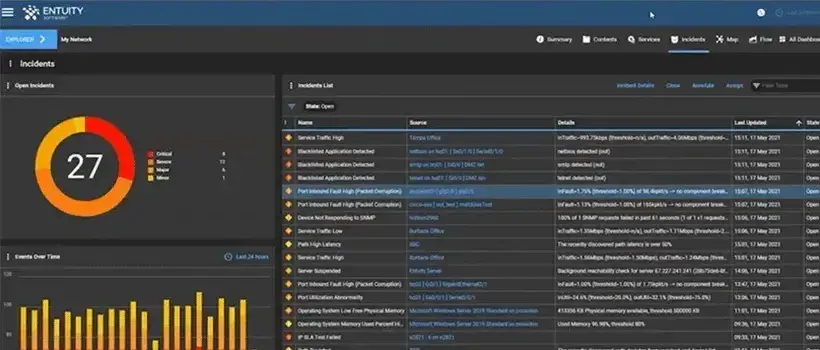
Our remote infrastructure monitoring services ensure your on-premise, edge or hosted data center is regularly monitored to identify any performance dips or unrealized opportunities for improvement. Not to mention our proprietary tool Entuity Software™, that delivers real-time analytics, performance insights and path tracking for your private or public cloud instance.
Looking to transition to the cloud? Our public cloud services include planning, migration, support and optimization of public cloud environments such as AWS and Azure. Additionally, Park Place Technologies offers a range of cloud services to unlock efficiencies for your infrastructure. This includes infrastructure as-a-service (IaaS), disaster recovery as-a-service (DRaaS) and data protection as-a-service (DPaaS).
Contact us today to achieve efficient hybrid cloud management.